One of the biggest challenges in furnace measurement, whether in reformers, crackers, or fired heaters, is deciding which wavelength is best suited to the application.
In most Hydrocarbon and Petrochemical Industry furnaces, background temperatures are almost always higher than the tube surfaces being measured. Because this is such a common condition, the guidance below focuses on that scenario.
Customer familiarity and existing practice
Before comparing wavelengths, it is important to consider the human factor. Many customers have extensive historical data based on a particular wavelength.
If they are comfortable with that wavelength and understand how to work with the data, this carries real operational value. Even after the advantages and limitations of 1 µm and 3.9 µm are explained, some users prefer to stay with whichever wavelength they know. As long as this wavelength is either 3.9 µm or 1.0 µm there is no issue with this, provided the limitations are understood and taken into account.
Portable pyrometers and furnace conditions
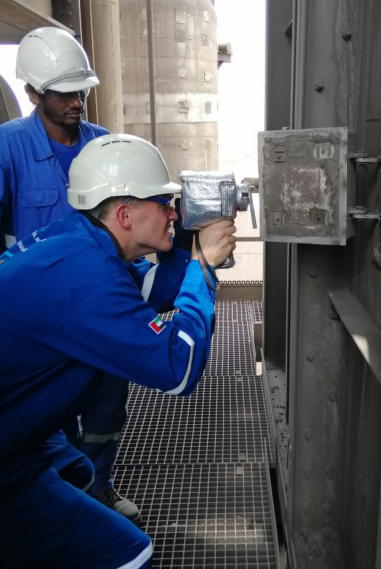
Portable measurements present a unique challenge because a Cyclops has a relatively small spot size, and the user must manually scan to ensure they capture the area where the highest background radiation is acting on the tube. This is difficult in a live furnace to ensure you get the hottest spot radiating onto a tube.
Under these conditions, the longer 3.9 µm wavelength is less influenced by higher background furnace temperatures than 1 µm. This makes it more stable if refractory hotspots are present but are not captured in the background data, and more representative of the true tube temperature in real furnace conditions.
Emissivity considerations for portable measurements
There is an important trade off to consider when using 3.9 µm. The corrected temperature at this wavelength is more sensitive to emissivity accuracy.
In reformers and cracking furnaces, tube emissivity changes slowly over time. Accurate emissivity values can be established using the Gold Cup or through periodic Gold Cup surveys, allowing reliable temperature measurements to be maintained.
Taking these factors into account, the Cyclops 390 (3.9 µm) is usually the better choice for portable measurements of furnace tubes.
Fixed thermal imaging systems
Fixed thermal imaging systems remove many of the challenges associated with handheld devices. Rather than relying on a single spot measurement, a thermal imager provides a complete view of the furnace.
This makes it easier to identify areas where background radiation is highest and to apply appropriate background correction.
 High resolution 1 µm imaging
High resolution 1 µm imagers, such as the NIR-b-2K, offer clear advantages for fixed installations. These systems provide significantly higher resolution than standard resolution MWIR-b imagers and can resolve fine tube detail from long distances.
This provides exceptional clarity for trending, diagnostics, and process optimisation. Because the imager shows the entire scene at once, finding hotspots and correcting for background becomes straightforward.
When combined with regular Gold Cup surveys and background correction in the image, 1 µm imaging delivers a high level of measurement accuracy.
Lower temperature applications
Some lower temperature applications are not suitable for measurement at 1 µm. In these cases, MWIR solutions such as the MWIR-borescope remain very effective tools and provide reliable performance where 1 µm cannot be used.
Making the right choice
Choosing between 1 µm and 3.9 µm depends on the measurement method, furnace conditions, and application requirements, rather than one wavelength being universally better than the other.
• For portable pyrometers, Cyclops 390 (3.9 µm) is usually the better choice for furnace tube measurements.
• For fixed thermal imaging systems, a high resolution 1 µm imager should be used whenever possible.
Download the application note