Conveyor belts are essential tools for transporting fuel in many in coal- and biomass-fuelled industrial processes. They can be found power plants, in fuel production facilities and at railheads and ports where the fuel is loaded and unloaded.
Oxidation can cause stored fuel to heat up and even to spontaneously combust, so it is important to check that the fuel is in a safe condition before passing it on to the next stage of the process. A fire on a conveyor can damage the belt, whilst a fire on a train or ship can cause serious damage to the structure and could pose a risk to personnel on board. If possible, the fuel should be monitored using a sensor which can detect a small hot spot well below the point at which it could ignite, so that it provides an early warning of a hazardous condition.
Infrared sensing is a fast, accurate and non-contact method for measuring temperature, so it is ideal for this type of measurement. Measuring the temperature of a hot spot allows the operator to monitor temperature trends, unlike a spark detector which simply indicates that a bright object has been detected.
As with all industrial measurements, the best choice will be determined by the details of the application, required temperature range, preferred communications and budget. Detecting a small hot spot on a fast-moving conveyor requires a combination of speed and sensitivity as well as good spatial resolution. AMETEK Land offers a range of products including:
•
SPOT+ M210 pyrometer
•
HotSpotIR scanner
•
LWIR-640 thermal imager

The
SPOT+ M210 pyrometer is fast and sensitive with a temperature range of 50 to 1100 °C. It is a single-point measurement and its field of view is 60:1 so a SPOT+ installed 2 m from the belt will measure a 33 mm wide strip along the length of the belt. Since it does not cover the whole width of the conveyor, it could miss a hot inclusion that is outside its field of view. This means it is only suitable for use in applications where such an inclusion is unlikely. The minimum temperature range of 50 °C allows it to sense hot material, but it will not be able to detect variations in the normal temperature of the material being transported.
Both
HotSpotIR and
LWIR-640 cover the full width of the conveyor, so they are able to detect hot spots as small as 10 mm across on a 1 m wide conveyor.
HotSpotIR has a single detector and a rotating mirror which scans across the belt up to 100 times per second. Each scan line has 1000 measuring points and is typically 12 mm wide. The belt moves between each scan so the coverage depends on the speed of the belt; a belt travelling at 4 m/s will move 40 mm between scans, so the HotSpotIR can detect hot items with dimensions greater than 40 mm.
 Figure 1. Linescanning generates a two-dimensional thermal map of material on a moving conveyor.
It is available with a measuring range down to 20 °C, so it will provide measurements down to a typical ambient temperature range. When connected to the
LMG MkII processor, it provides a graphical display showing the temperature distribution across the belt along with the peak temperature and two alarm relays which are activated if it senses a peak temperature above programmed limits. These will typically be configured as a warning and a critical temperature. An optional 4-20 mA signal allows the control system to track the measured temperatures, both peak and zone average. HotSpotIR is a very rugged device with a small, hard sapphire window which can be purged easily, so it is very well-suited to the harsh environment around a coal conveyor.
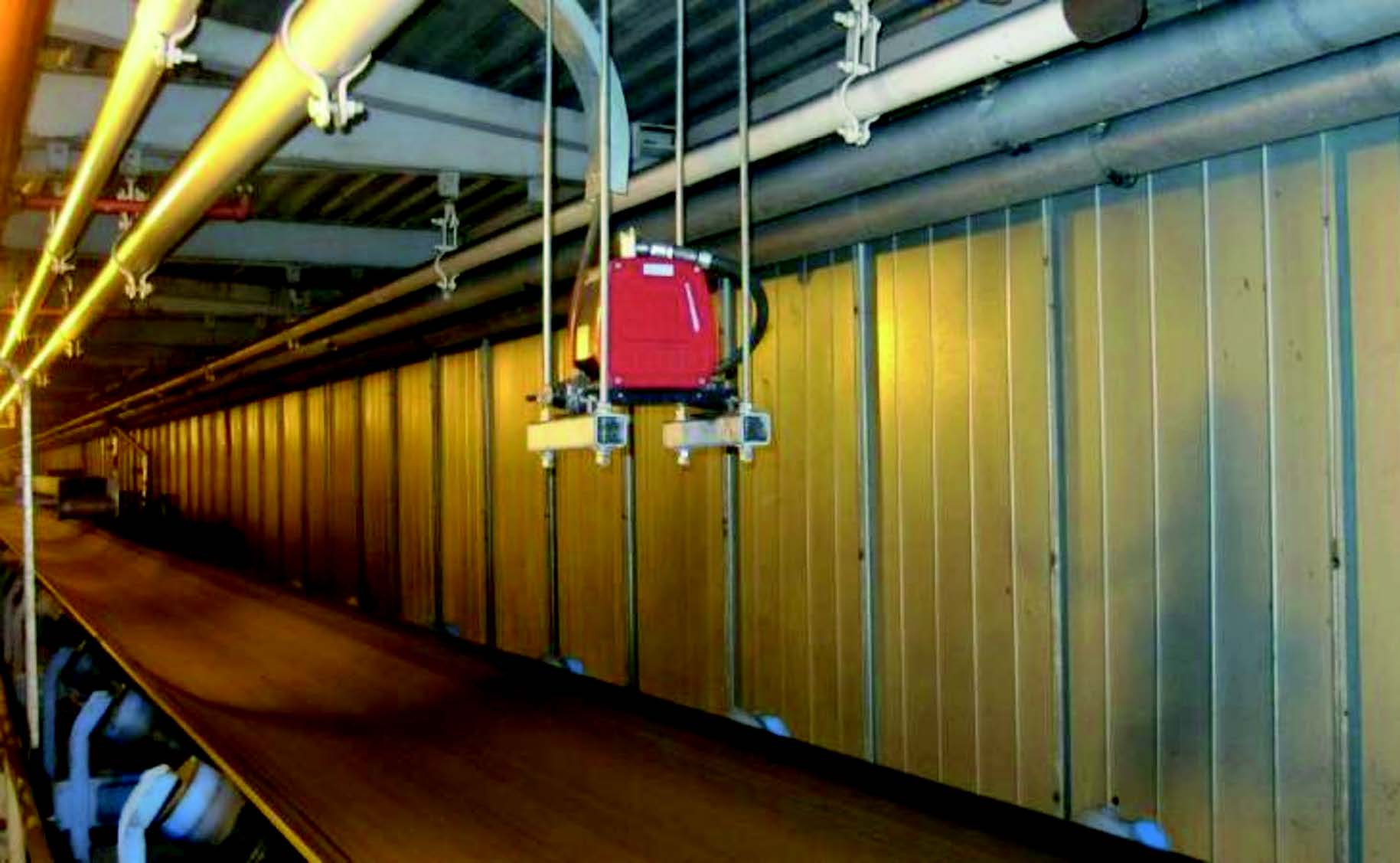
Figure 2. AMETEK Land HotSpotIR installed above a conveyor
The
LWIR-640 thermal imager is available with a frame rate of 60 Hz and a choice of different lenses with both wide and narrow fields of view (FOV). The 50° x 37° lens is a good choice for most conveyor applications, covering an area of 1.68 x 1.38 m when installed 2 m above the belt. Each pixel covers an area 3 mm across so, allowing for a minimum area of 3 x 3 pixels, the LWIR-640 can detect a hot inclusion as small as 9 mm.
In practice, the movement of the belt between frames means that there is some blurring, but it is still able to detect a small, hot inclusion. An advantage of the LWIR-640 is its low-temperature sensitivity; the preferred temperature range for conveyor applications is 0 to 500 °C, so the conveyor and surroundings are clearly visible in the thermal image. A PC is needed to configure the LWIR-640 but, once it has been commissioned, it is a standalone device providing one 4-20 mA output and two relays. Advanced image processing is available from the
IMAGEPro software package, but this is not generally needed for conveyor measurements.
Although it is fully weatherproof, one drawback of the
LWIR-640 is its exposed lens. It is larger than the
HotSpotIR window which makes it harder to purge, and its optical coating is more easily damaged than a sapphire window.
The LWIR-640 should therefore be specified only on applications where the lens can be protected from a buildup of coal dust.
Because a high concentration of combustible dust constitutes an explosion hazard, the area around a conveyor can be classed as a hazardous area. The LWIR is available with a flameproof enclosure which allows it to be used in both Zone 21 and Zone 22 hazardous areas.
Conclusion:
As is common in industrial measurement, no measuring device is ideal for all situations.
•
SPOT+ M210 offers a simple and economical measurement, but it has limited coverage and cannot measure down to room temperature.
•
LSP-HD21 offers good coverage in an extremely robust package
•
LWIR-640 has excellent coverage, but its lens must be protected from dust accumulation. It is also available in a flameproof housing for use in hazardous areas.