Many industrial processes involve flammable or explosive materials. These include the oil and gas, chemicals, coal and metals industries.
A hazardous area is one where a fire or explosion hazard may be present, either as an inevitable part of the process or as a consequence of an abnormal condition such as a gas leak. Equipment used in a hazardous area must be designed so that it cannot be a source of ignition through sparks, hot surfaces or discharges of static electricity.
Thermal imagers and pyrometers are used in a wide range of hazardous areas in industries such as chemical and petrochemicals, fuel handling, metals and semiconductors. Some of the most common applications are in chemical and petrochemical industry applications.
There are several protection mechanisms which are recognized in the standards. Some are only applicable to the lower-risk categories such as Div 2 or Zone 2 whereas others may be used in all categories. Among the most common are:
• Explosion-proof or Flame-proof (Ex d) - Any fire or explosion occurring within the enclosure will be contained and cannot ignite material outside.
• Intrinsic Safety (Ex i) - The electrical equipment cannot generate enough energy to ignite a flammable mixture, either through a spark or through elevated temperature.
• Purged and Pressurized (Ex p) - The enclosure containing the electrical equipment is purged with inert gas and maintained at a pressure above the surrounding atmosphere, to prevent ingress of flammable material.
 LAND
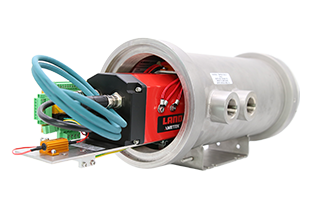
LAND is now able to mount
LWIR thermal imagers and Ex
SPOT+ pyrometers inside an Ex d housing which allows them to be used in a wide variety of hazardous areas having both gas and dust hazards. Worldwide certifications to IECEx, ATEX and UKEX standards allow accurate and reliable temperature measurements in Zones 1, 2, 21 and 22. The housing is manufactured from 316 stainless steel for extreme corrosion resistance, and a gridless window design means an unobstructed field of view.
Some of the most common applications for temperature measurement and thermal imaging in hazardous areas are:
Critical vessel monitoring
Refractory-lined vessels and furnaces are common in industrial applications such as petrochemicals, steel production, processing and heat treatment. Over time, refractory deteriorates to a point where it has to be relined. Traditionally, the timing of a reline is ad-hoc and based on guidance from licensors, and previous experience of refractory issues. However, this approach is not data-driven and can lead to critical and dangerous leaks of toxic gases, or an explosion resulting in plant damage, income loss and in the worst case, injury to personnel. The continuous maintenance and monitoring of vessels and furnaces are therefore essential to production reliability and a plant’s throughput. Automated monitoring of the shell temperatures of vessels’ and furnaces’ critical areas using the AMETEK Land Asset Monitoring System enables their condition and safety to be continuously assessed to avoid leaks or identify dangerous outbreaks.
Storage pile monitoring
Coal and biomass fuel for power generation may be stored in large piles, either under a dome or in the open air. Coal and biomass react with air to form carbon monoxide. This is an exothermic reaction and can create hot spots, which may lead to spontaneous combustion. An
LWIR-640 imager can identify hot spots early, to keep personnel safe, prevent plant damage and avoid loss of coal and biomass stock. In the oil and gas industries, petcoke derived from the refining process and sulphur from the sulphur recovery unit are stored in large piles and are also susceptible to spontaneous combustion. The LAND Storage Pile Monitoring system, based on an array of LWIR-640 imagers provides an effective method for providing early warning of spontaneous heating 24/7.
Continuous annealing lines with reducing atmosphere
The continuous annealing line (CAL) is used to modify the grain structure of steel through heat treatment, changing properties including hardness and strength. The process involves several stages, focused on controlled heating and cooling to produce steel with the required qualities. Accurate temperature monitoring and control in each zone is essential for process and quality control. The Spot range of pyrometers allows for accurate temperature measurements throughout all stages of the CAL.
Flare stack monitoring
Flare stacks are widely used in the chemical, petrochemical, steel and other industries to safely dispose of excess gases through combustion. Waste gases, and flammable gases released to prevent unplanned over-pressurizing of plant equipment, are flared or burnt off high above the ground. Simply venting untreated hydrocarbons into the air creates an environmental hazard. Burning these gases is less harmful – combustion products such as carbon dioxide and steam are safer to release and less damaging than methane and other volatile organic compounds. Environmental regulations demand continuous monitoring of flare stacks to ensure the pilot light is always lit, and to prevent pollutants and unburned hydrocarbons from entering the atmosphere. The LAND Flare Stack Monitoring system allows the flare stack to be monitored continuously, even under adverse weather conditions which make it difficult for a visible light camera to obtain a clear image.
Click here to learn more about our Hazardous Areas Solutions