Slag carryover during tapping can quietly erode yield, disrupt downstream processes and place additional pressure on operators.
When it occurs repeatedly, the impact is not always obvious in isolation, but over time it affects productivity, material recovery and the overall consistency of the operation.
Reducing these losses starts with greater visibility, moving beyond operator experience or observation to objective, reliable measurements that support confident decisions on when to act and when to stop.
The challenge of controlling slag during tapping
 This challenge is familiar to many steel producers. One example is Celsa Steel UK, one of the UK’s largest producers of steel reinforcement products, manufacturing around 1.2 million tonnes of finished steel each year. During electric arc furnace tapping to the transfer ladle, slag carryover was occurring too frequently, leading to steel losses, ladle tipping delays and reduced recovery of valuable ferro alloys.
At the time, operators monitored the tapping stream manually and intervened to limit slag entering the ladle. While effective to a degree, this approach could not deliver the level of consistency or accuracy required, particularly in a harsh melt shop environment where smoke, dust and fumes regularly obscure visual cues.
What was needed was a more dependable way to monitor the transition from liquid steel to slag, alongside clear insight into ladle fill level during tapping.
A measurement‑led approach
Following evaluation of several available solutions, Celsa implemented LAND’s Slag Detection System (SDS) to support more controlled tapping.
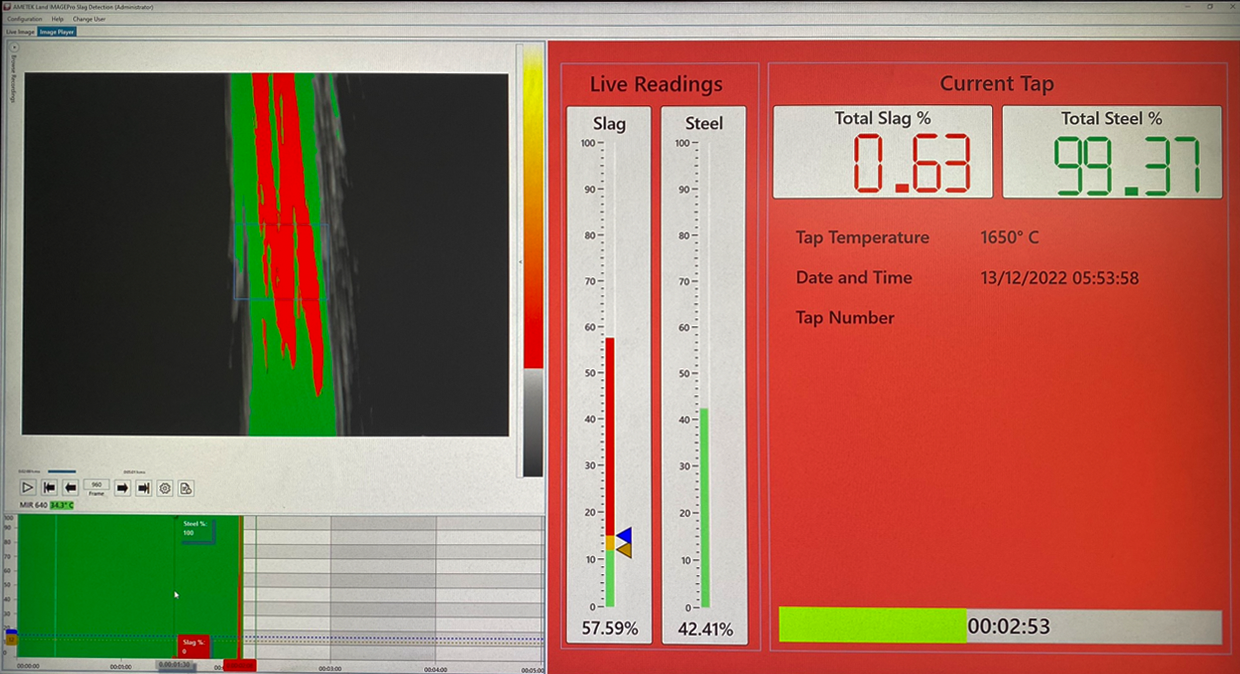
Installed at the tapping position, the system provides a clear view of both the pouring stream and ladle freeboard. The high-resolution thermal imaging camera operates at a 3.9 micrometre wavelength, monitoring the transition between liquid steel and slag and maintaining visibility in conditions where conventional optical systems often struggle.
By combining slag detection with ladle freeboard level monitoring, operators can see exactly how the tap is progressing. When slag exceeds a defined threshold or the ladle approaches its maximum allowable level, alarms can be triggered to prompt intervention or, where configured, automatically stop the tap.
This combined view of stream condition and ladle fill enables closer control of the tapping process, helping to reduce slag carryover while minimising the risk of overfilling.
Turning visibility into consistent results
Since installation, the Slag Detection System has delivered clear operational benefits. These include improved control of the hot heel, reduced ladle tipping and associated delays, and increased recovery of ferro alloys. Compared with traditional tapping stream monitoring methods, slag depths have been reduced by up to 25 percent, helping to protect yield and reduce downstream material additions during refining.
Operators are supported with real‑time data through LAND’s ImagePro software for slag detection, enabling faster response times and more consistent decision making at the end of each tap. Data logging also supports quality control and post‑process analysis, making it easier to review performance and identify opportunities for further optimisation.
Reflecting on the results, Scott Evans, Process Manager at Celsa Steel UK, noted that the system is delivering quantifiable cost benefits, contributing to improved productivity and efficiency, alongside a reduction in ladle tipping and better control of the hot heel.
Supporting more efficient steelmaking
As the steel industry continues to focus on efficiency and decarbonisation, reducing waste during core processes such as tapping becomes increasingly important. Limiting slag carryover helps maximise usable steel, reduce reprocessing requirements and support safer operation, without adding unnecessary complexity.
To learn more about how the Slag Detection System can support yield, efficiency and process control in your operations, speak with LAND’s measurement experts about your application.