Decarbonisation targets are becoming more ambitious with every passing year. Governments and regulators are pushing harder, timelines are tightening, and industries with energy-intensive processes are under increasing pressure to respond.
For refineries and petrochemical producers, this is not just a long-term challenge. It is something that needs to be addressed now.
In many cases, the quickest and most practical gains can be made by looking closely at fired heater processes. These assets sit at the heart of production, consume vast amounts of fuel, and are responsible for a significant proportion of site emissions. Two of the most carbon-intensive examples are steam methane reformers (SMRs) and steam crackers.
Both are well understood, heavily engineered, and critical to modern industry. Yet one area is still often underestimated in their optimisation: how well we measure, monitor and understand temperature inside the furnace.
Why SMRs and steam crackers matter in the decarbonisation conversation
Steam methane reformers are the dominant route for hydrogen production, accounting for a large proportion of global supply. They feed hydrogen into refineries and chemical plants for processes such as hydrotreating, hydrocracking, ammonia production and methanol production. Globally, SMRs are estimated to emit around 800 million tonnes of CO₂ each year.
Steam crackers, used to produce ethylene, are another major contributor, with emissions estimated at around 260 million tonnes of CO₂ annually. These furnaces operate at extreme temperatures, often close to material limits, and small inefficiencies quickly translate into lost yield, higher fuel consumption and increased emissions.
There is no shortage of discussion around hardware changes. Burner upgrades, new refractory materials and improvements in combustion design all have a role to play. But accurate temperature monitoring and control, which directly underpin how efficiently these furnaces run day to day, often receive far less attention than they deserve.
Hydrogen production and the efficiency challenge
In a conventional steam methane reformer, natural gas is mixed with steam and passed over a catalyst in the primary reformer. This produces hydrogen along with carbon monoxide and carbon dioxide. Further processing shifts the carbon monoxide into additional hydrogen and CO₂ these processes are called water gas shift reactors, before pressure swing adsorption is used to separate the hydrogen product.
Without carbon capture, this route produces what is commonly referred to as grey hydrogen. When carbon capture, usage and storage is applied, it becomes blue hydrogen.
Steam cracking and the hidden cost of temperature imbalance
Steam crackers operate in a different way, but temperature control is just as critical. Cracking reactions take place inside long radiant coils suspended within large fired furnaces. A range of feedstocks can be used, from ethane through to heavier hydrocarbons such as naphtha.
Operators rely on thermocouples to measure flue gas temperatures and coil outlet temperatures, which indicate cracking severity. Tube metal temperatures, however, are typically measured manually and periodically using infrared pyrometers.
Over time, coke forms on the inside of the coils. This is unavoidable, but how it develops and how it is managed makes a big difference. Coke acts as an insulating layer, reducing heat transfer from the furnace atmosphere into the colder process gas. Left unchecked, operators are forced to decoke the furnace on the tube metal temperature.
Because inspections and temperature measurements are often periodic rather than continuous, coke build-up and associated hot spots can go unnoticed. The result is reduced run lengths, higher maintenance costs and unnecessary energy use. From both an environmental and operational perspective, reducing coke formation is a priority and ensuring what coke does build up is not localised to a single hotspot.
Why better temperature data changes behaviour
As plants adjust operating strategies to reduce emissions, conditions inside furnaces are changing. Oxygen setpoints may be reduced. Hydrogen content in fuel streams may increase. Flame characteristics can shift, and components such as burner tiles and refractory may degrade faster than expected.
These trends increase risk. They also increase the importance of seeing what is really happening inside the furnace, rather than relying on assumptions or sparse data points.
 Traditional handheld pyrometers remain widely used and have an important role. However, single-point, manual measurements are inherently reactive. They only tell you what is happening where and when someone happens to be looking.
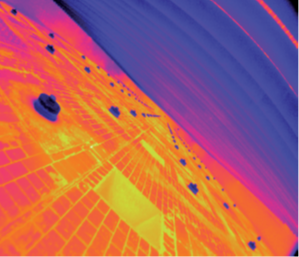
Thermal imaging changes that picture. Fixed systems provide continuous, real-time temperature data across large areas of the furnace. Portable imaging systems allow engineers to carry out detailed inspections, capturing high-resolution images and temperature profiles that would otherwise be impossible to obtain through peep doors alone.
This depth of data supports better decisions. It allows operators to identify uneven firing, flame impingement, refractory damage, insulation failures and early signs of coking.
Operating closer to the optimum window
There is a natural tendency to run furnaces conservatively. Tube failures are costly and safety is always a key concern, so many plants choose to stay well below design limits. The challenge is that this caution comes at a price.
A temperature increase of just 20°C above design limits can halve tube lifetime. On the other hand, operating 10°C below design temperature can reduce SMR productivity by around 1 percent. In steam cracking, running too cool means insufficient cracking severity and lost ethylene yield.
Accurate, reliable temperature measurement is what allows plants to operate confidently within that narrow optimum window. It supports higher throughput without sacrificing asset life or reliability.
Verifying accuracy with reference measurements
Non-contact infrared measurements depend on correct compensation for emissivity and background radiation. In the high-temperature, reflective environments of steam crackers and SMRs, this is not trivial.
 Reference measurements are essential for verifying accuracy. Tools such as the LAND Gold Cup Reference Pyrometer create black body conditions at the measurement point, producing readings that are independent of emissivity and incident radiation. Used periodically, these reference measurements help improve confidence in both handheld pyrometers and thermal imaging systems.
This combination of continuous monitoring and periodic verification is what turns temperature data into something operators can trust and act on.
Incremental improvements add up
Decarbonisation is not a single project or a single technology. It is a series of incremental improvements, applied consistently over time. For fired heaters, better temperature visibility supports better combustion, improved heat transfer, longer asset life and higher yields, all of which reduce fuel use and emissions.
Digital solutions and infrared technologies are not new, but the way they are applied is evolving. With the right technical understanding, they can play a meaningful role in helping steam cracker and SMR operators navigate an increasingly competitive and carbon-conscious landscape.
Often, improving efficiency starts with simply seeing the process more clearly.